Work · architecture · data · operations
Production AI fails at the seams.
I build and review the systems at those seams: where models meet state, tools meet authority, data meets context, and a promising demo meets operating reality.
Three ways to work together
Choose the intervention that matches the problem.
Architecture review
A focused, evidence-backed assessment of what an existing or proposed agent actually does, where it can fail, and what must change before the next production decision.
View the review process → 02Reference build
One difficult production seam built to a usable standard—memory, evaluation, data foundations, execution, or control—then handed over with runbooks and decision records.
See the reference builds → 03Embedded enablement
Work alongside the team until they can run, extend, and govern the system themselves. Capability transfer is part of the deliverable. Offered only after a review verdict, not as a parallel entry.
Follows the review →Selected proof
Built around production seams.
 Agentic AI
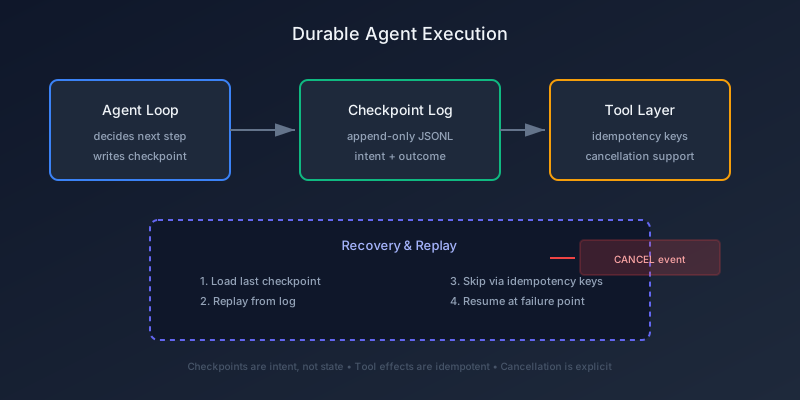
Durable agent execution
Checkpoints, cancellation, idempotent effects, and replayable failure evidence for work that outlives a process.
Read the case study →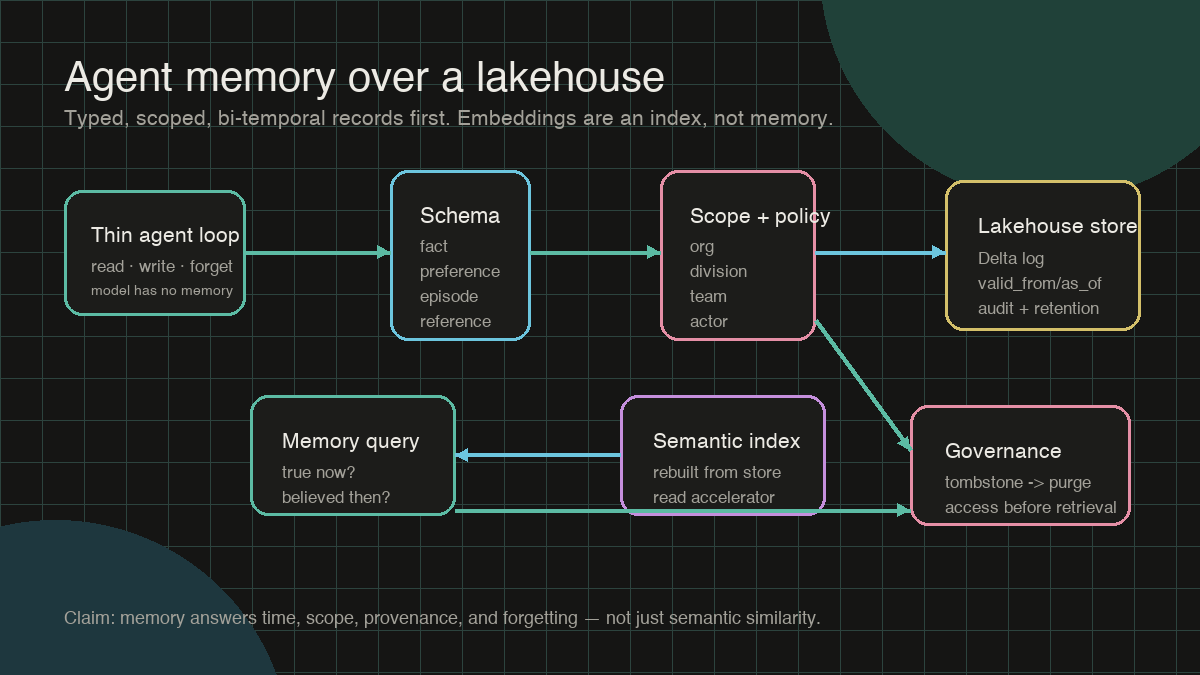 Agentic AI
Agent memory over a lakehouse
A public typed, scoped, bi-temporal memory implementation, with 59 tests and six scenarios rerun.
Inspect the verified case study →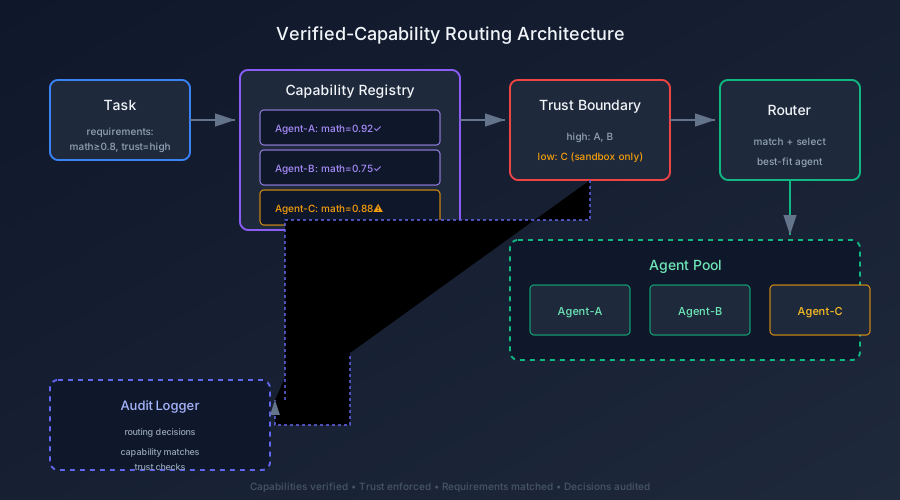 Agentic AI
Verified-capability routing
A public, tested implementation of requirement-driven selection, trust checks, capability decay, and reconstructable routing evidence.
Inspect the verified case study →Reference-build archive
Eleven implementations you can inspect.
Agent systems6 builds
Data foundations2 builds
Platform and control3 builds
Current portfolio
A growing set of production seams.
Eleven reference builds currently cover memory, evaluation, privacy, routing, execution, data foundations, exception handling, sandboxing, model control, and governance. New use cases can be added as the work evolves.
How I work
The team should be able to run the system after I leave.
Have a production question?